

- About
- Services
- Partners
- Events
- Jobs
- Courses
- About
- Services
- Partners
- Events
- Jobs
- Courses

As a parent, Are you trying to get answers to your questions like:
If yes! Well, You are in the right place.
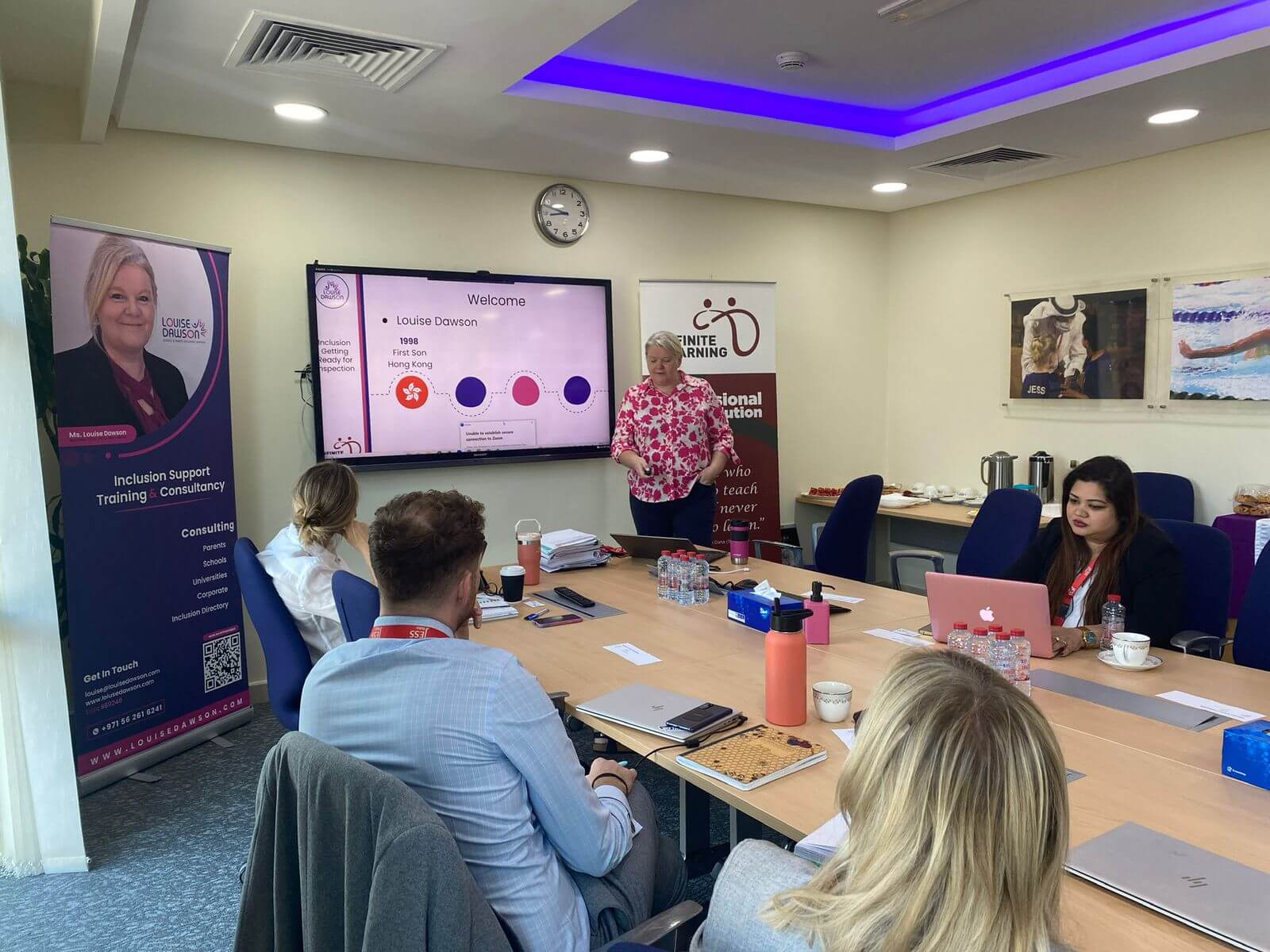
Louise’s experience and connections in the Middle East enable her to advise on many aspects of education and clinical support for families.
Louise is able to provide training and support on how parents can work with their children and schools. She is also skilled at training parents to resolve conflict, enabling both parents and school to understand the challenges and provide the best possible care and education for diverse young.
If we don’t know how to help – we are confident we know the people who can.
Louise has:


Parents often ask similar questions about how to best support their child’s learning journey, especially regarding educational differences and emotional well-being. This FAQ section provides compassionate, practical guidance and expert insights on common challenges. The advice is drawn from the frequent Q&A sessions, parent meetings, and conferences we’ve held.
Every child is different.
I am available for 1:1 meetings, online meetings and all sorts of support. There is a lot of information on my website and it is growing every day.
My whatsapp is +971 56 261 6241 and my email is Louise@LouiseDawson.com
You can book an online meeting at any time at the link below:
First, remember this: their reaction says more about them than about your child. People often act out of ignorance, not understanding. You can choose to smile, walk away, or you could calmly explain your child’s needs — whichever feels right in that moment. Reframe the situation: every time this happens, you are modeling resilience and acceptance for your child. Your positive reaction will teach them that they are valued and that other people’s opinions do not define them.
Start with little steps. Encourage your child to use their own voice in safe spaces: asking the teacher for help, ordering in a café, explaining what helps them learn. Role-play at home to build confidence. Over time, teach them the language to describe their needs (“I learn best when…”, “I find it hard when…”). Advocacy is a muscle — it gets stronger with practice.
Dubai has increasing options: inclusive colleges, vocational training, and career counselling centres. Many universities here (and abroad) have support offices for students of determination. Vocational paths, internships, and skill-based training can be a great fit too. The Knowledge and Human Development Authority (KHDA) has resources, and there are private counsellors who specialise in transition planning. Dubai College of Tourism has just expanded to some early careers courses, there is a culinary arts centre for budding chefs, all sorts of art and craft making courses…..this truly is a rich city of diversity and opportunity. Often it is all just hidden.
Co-regulation is key — your calm presence helps them calm too. Create a toolkit of strategies together: deep breathing, sensory tools, drawing, listening to music, or taking a walk. Normalize talking about feelings, and let them know anger/anxiety are not “bad,” but signals their body is overwhelmed. Over time, help them recognize triggers and practice coping strategies in calmer moments. Practice strategies when children are calm, before dysregulation – you can not learn whilst you are in distress.
Do some reading on emotional regulation such as:
In Dubai, there are parent-led groups for families of determination (often connected through schools or KHDA networks). Online communities — especially ADHD and autism groups — can be a lifeline. Connecting with other parents who “get it” is powerful and healing.
There is a Parent App called SEN2Gether which is one of my favourites. I collaborate with them on ‘hot topics’, they host podcasts and they have chat forums.
We have a Social Group for those aged 13 to 21 on alternate Saturdays in Arjan. The kids come and have fun but the parents come and chat! Most schools have groups and parent support. There are also Facebook groups for all sorts of conversation.
You can follow my socials on @LouiseInclusion (all platforms) and we regularly share events.
Adapt the environment: reduce distractions, provide clear instructions, and use checklists. Adapt tasks: shorten them, add breaks, or give options for how to show learning. Adapt expectations: progress is individual — compare to his past, not to peers. Above all, adapt your mindset: patience and encouragement are the most powerful tools you have.
Sometimes children rely on LSAs for comfort, and that’s okay — but the goal should always be independence. Talk to the school about gradually shifting the LSA’s role from “protector” to “facilitator.” For example, the LSA could step back during group work, prompting your child to connect with peers instead. It’s about small steps toward confidence, not removing support all at once. Every LSA should have a log and this should be checked once a week. Broken down into a positive and improvement point for each lesson. One page per week so you can look for patterns.
English: Wrote a paragraph. Struggled with putting ideas down.
Maths: Completed first 3 tasks. Went to the bathroom four times.
Tracking enables us to show moments of brilliance and moments of struggle; this in turn helps everyone to plan for success. Knowledge is power.
ADHD is not about a lack of ability — it’s about a different way of processing the world. Build routines, break tasks into smaller steps, and celebrate small wins. Movement breaks, hands-on activities, and giving choices can make a huge difference. Most importantly, notice their strengths: creativity, curiosity, energy — and remind them often that these are gifts.
ADHD is a vast array of different strengths and challenges. Without knowing your child well I am unable to give specific advice that is relevant for a specific person. Talk to them, ask them if they are struggling, ask them if they want help (they may not) and then work out together how to help that specific challenge. There are a million different strategies and a million different needs. ADHD, like most neurodiversities, is an umbrella term for lots of presentations.
You can start anytime — it’s about gentle scaffolding, not pressure. Begin with very short, achievable study bursts (5–10 minutes), followed by breaks. Use timers, visuals, or reward charts if they’re motivating. Slowly increase the time as focus grows. The key is consistency and keeping it positive.
Take a look at Time Timer as one example of a resources:
Parenting a gifted child with ADHD can feel like running two marathons at once. Acknowledge his intelligence, but also his emotions — high IQ doesn’t mean low needs. Give him responsibility for managing some aspects of his life (study schedule, hobbies, chores), while you hold clear but kind boundaries. Protect your own wellbeing too: you can’t pour from an empty cup. It’s okay to step back, breathe, and trust his resilience.
Do some reading on ‘multiple and dual exceptionality’ such as:
Boundaries work best when they’re co-created. Sit with your child and agree on what feels fair — for example, screen time after homework, or tech-free zones (mealtimes, bedtime). Use timers or apps if needed, but keep the conversation respectful. Framing it as balance, not restriction, avoids power struggles.
Do some reading on boundary setting such as:
Friendship is not always about quantity — one genuine friend is worth more than a crowd. Support them by creating opportunities for shared interests (clubs, sports, gaming, arts). Role-play social skills, but also reassure them that being different is not being “less.” Celebrate their uniqueness, and encourage connections where they feel safe and understood. In primary, I rotated and invited every child, one at a time, to dinner once a week – or to a movie, or a play centre, or an art event. Allowing my child time away from school, to build relationships in mutually fun activities enabled better connection in school. Contrary to popular belief, many children don’t have time to force secure friendships in school.
Also, contrary to popular belief many of us don’t wish to form relationships with many different people. Sometimes it is too exhausting. So be sure to ask your child what they want, how they feel and how they would like to proceed. Their voice is most important and maybe that one friend is enough.
Do some reading on making friends setting such as:
This is such a common feeling. You’re not alone. Give yourself permission to step back — trust that your child can cope, even for short periods. Build in breaks for yourself without guilt. The more you look after your wellbeing, the more present and patient you’ll be for your child.
Analyse ‘what are you worried about’ and remember that you can tell a child a 100 times that the oven is hot; they don’t truly learn that until they have touched it. You have to trust them to make good choices and you then have to trust that they will get themselves out of any sticky holes. I found little things like having an ‘agreed’ upon tracker gave me comfort (but they could also always track me). What is good for them is also good for me. If you want them to tell you that they are going to be late; you have to tell them when you are going to be late. Parenting is about modeling and showing, slowly letting go, giving trust, resetting the boundaries when the trust falters, and putting them back on the road – again and again – until it works.
Autistic teenagers need the same things as any other teen: respect, autonomy, and belonging. Keep communication open, offer choices, and listen without judgment. Predictability and routines help reduce stress. Remember — adolescence is hard for everyone, and extra patience and empathy go a long way.
Yes — sensory toys, visual schedules, emotion cards, mindfulness apps, and simple fidget tools can all help. Local therapists, support centres, and online communities (like ADDitude or Understood.org) also provide strategies and reassurance.
If you would like specific advice please don’t hesitate to get in touch.
Stay calm, keep your tone steady, and model regulation. Afterwards, when things are calm, talk through what happened and what strategies might help next time. Build a “calm corner” at home where your child can retreat safely when emotions spike (this can be just their bedroom). Remember — an outburst is communication, not defiance.
Start small. Play games that gradually build focus — memory games, puzzles, timed challenges. Use gentle prompts and give extra time to respond, without rushing them. Practice grows the skill, and confidence reduces hesitation.
Practical strategies work best: break learning into short steps, use visuals and real-life examples, and keep tasks multi-sensory (write, draw, act it out). Repeat often, but in different ways. Focus on progress, not perfection — celebrate every new skill.
Every child needs support, it is how and when to implement it most parents struggle with.
You are not alone!
You can book an online meeting at any time at the link below: